Mostrando entradas con la etiqueta astronomia. Mostrar todas las entradas

17 de noviembre de 2015

El planeta más parecido a la Tierra no es habitable


¿Encontraremos algún día vida extraterrestre? Para encontrar una respuesta afirmativa a esta pregunta, misiones como Kepler sondean el espacio en busca de posibles mundos similares a la Tierra. Localizar estos exoplanetas "objetivo" nos permite centrar mejor la búsqueda de organismos vivos fuera del Sistema Solar. Los investigadores habían señalado hasta la fecha el potencial de Kepler-438b, considerado como el exoplaneta más destacado, ya que cuenta con un índice de similitud con el planeta Tierra del 88%.

Las esperanzas depositadas en este mundo, denominado popularmente como "otra Tierra" desde su descubrimiento en enero de 2015, han sufrido un inesperado revés. Un estudio, publicado en la revista Monthly Notices of the Royal Astronomical Society, afirma que las grandes cantidades de radiación que recibiría Kepler-438b convertirían a este exoplaneta en un "lugar inhabitable". El mundo, que es un 12% más grande que la Tierra, estaba considerado hasta el momento como una especie de "gemelo planetario". Solo que se encuentra fuera de nuestro Sistema Solar, a 470 años luz, en un lugar conocido como "Ricitos de oro" (Goldilocks).
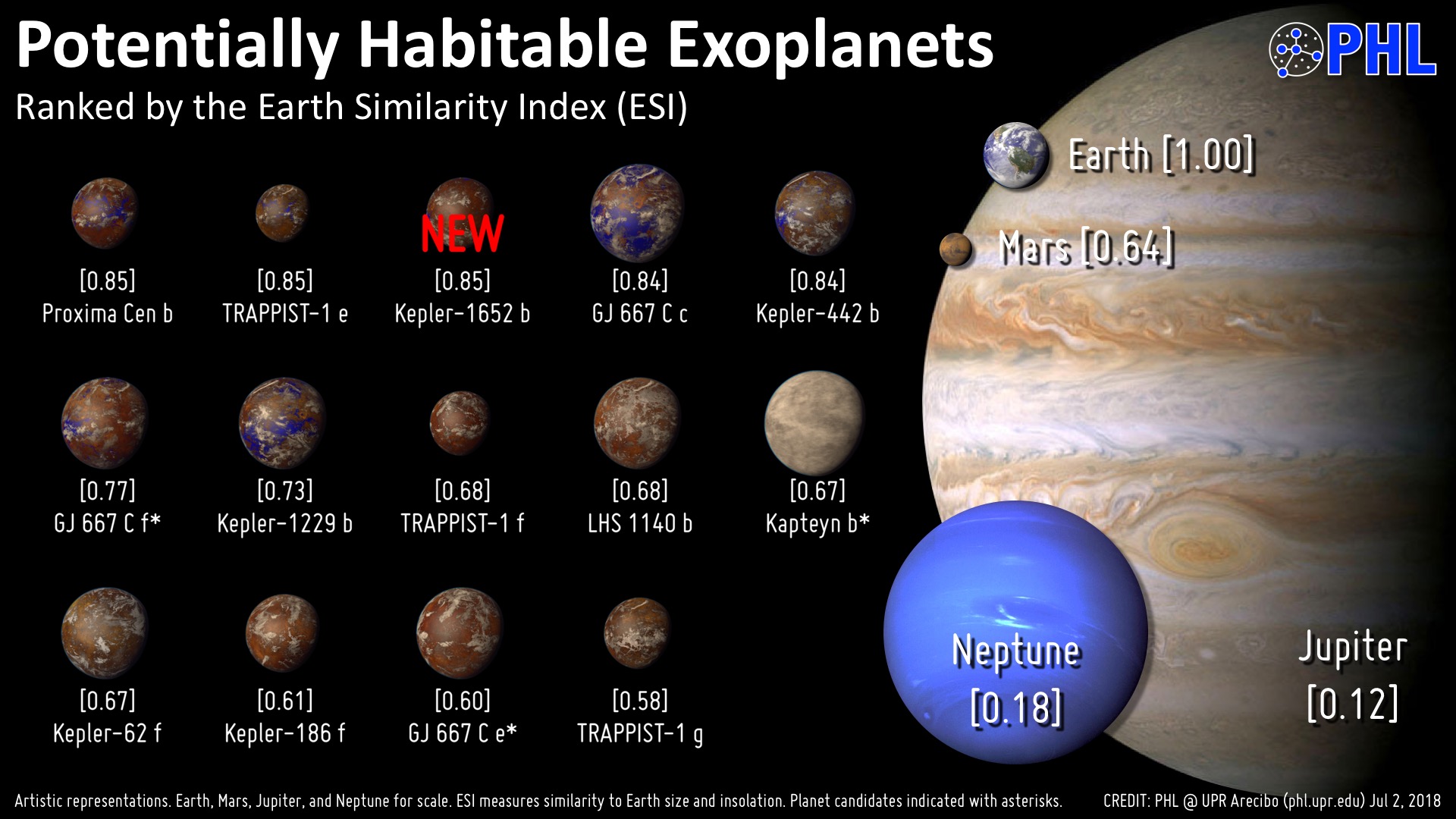
Según fuentes consultadas por Hipertextual, la investigación ha analizado parámetros como la rotación, la luz y las llamaradas solares que reciben diversos exoplanetas, entre los que también está Kepler-438b. De acuerdo a los científicos de la Universidad de Warwick, "la atmósfera podría haberse desvanecido como consecuencia de la radiación emitida por la enana roja a la que orbita". Como nos explica David J. Armstrong por correo electrónico, "Kepler-438b está cinco veces más cerca de su estrella que la distancia que separa a la Tierra del Sol". Esta proximidad provoca a su vez que las grandes llamaradas emitidas tengan un efecto mayor en el exoplaneta.

"Como resultado, hay una gran cantidad de radiación golpeando a Kepler-438b", nos cuenta Armstrong. Si hubiese una atmósfera protegiendo al exoplaneta, sería mucho más difícil que esto sucediera. Por desgracia, laseyecciones de masa coronal (en forma de explosiones de plasma, electrones y protones) de la enana roja parecen haber "despojado fácilmente" la atmósfera de Kepler-438b, prosigue el astrofísico, primer firmante del artículo. Al perder esta "capa protectora", el exoplaneta se vería afectado por unas elevadas tasas de radiación, que reducen mucho las posibilidades de que esté habitado. Para confirmar estas conclusiones iniciales, Armstrong apunta que deberíamos estudiar la atmósfera (si aún contara con algún resto), pero su lejanía complica mucho los trabajos.
A pesar de que se han reducido las probabilidades de habitabilidad del exoplaneta más parecido a la Tierra, el científico se muestra optimista. "Se trata solo de un mundo, tenemos muchos más sistemas que podrían ser propicios para hallar vida extraterrestre", comenta a Hipertextual. Según Armstrong, la investigación ha permitido demostrar que "no todos los exoplanetas similares a la Tierra son buenos lugares para la vida tal y como pensamos que existiría". Preguntado sobre el futuro de la Tierra y el Sol, el astrofísico rechaza que pudieran vivir en el futuro un proceso parecido al experimentado por Kepler-438b. "El Sol es una estrella muy diferente a esta enana roja. Lo que probablemente nos encontremos dentro de miles de millones de años es un Sol convertido en una gigante roja, que se expandirá y probablemente engullirá a la Tierra". Un escenario sumamente lejano en el tiempo que, posiblemente, no llegaremos a ver nunca.

Fuente: Hipertextual

14 de octubre de 2010

El color real de Io, una de las lunas de Júpiter

La foto que acompaña esta anotación es Io, una de las lunas de Jupiter y de las más curiosas de nuestro sistema solar. Se muestran los colores para que aparezca de la misma forma en que la veriamos si la tuviéramos en frente. La imagen fue realizada en 1999 por la sonda Galileo que orbitó Júpiter desde 1995 hasta 2003.


Azufre y roca de silicato son los responsables del peculiar color de Io. Tiene más de 400 volcanes, lo que lo convierte en el objeto geológicamente más activo de nuestro sistema solar. Eso se debe a que la fuerte gravedad impuesta por Júpiter genera tal fricción en el interior del satélite que causa la disipación de inmensas cantidades de energía, un fenóneno mejor conocido como marea gravitatoria.

Dicho fenómeno causa que lava sea expulsada constantemente a la superficie, es como si el planeta estuviera de adentro hacia afuera. De hecho, varios de los volcanes de Io producen nubes de azufre que se llegan a elevar hasta los 500 kilómetros.

Io es uno de los cuatro satélites galileanos, y tal como su nombre lo indica fue descubierto por Galileo Galilei en enero 7 de 1610, aunque se considera que el aleman Simon Marius también hizo el descubrimiento independiente de los mismos satélites en las mismas fechas. Hoy en día estos cuatro satélites de Júpiter reciben los nombres impuestos, justamente, por Marius, Ío, Europa, Ganímedes y Calisto.


Fuente: ALT1040

¿Cómo verían astrónomos alienígenas nuestro sistema solar?

Imaginad que exiten los extraterrestres. Y que han evolucionado lo suficiente como para haber tenido a su propio Galileo, y luego a una pléyade de astrónomos capaces de escudriñar el espacio exterior. ¿Cómo verían esos astrónomos alienígenas nuestro sistema solar?

Mediante el tratamiento e interpretación de las numerosas interacciones de miles de granos de polvo, una simulación generada por un superordenador de la NASA ha mostrado cómo sería lo que verían los astrónomos alienígenas. Los investigadores pudieron utilizar en su simulación más de 75.000 partículas de polvo interactuando con los planetas exteriores, la luz del sol o el viento solar.

El tamaño de las partículas de polvo en el modelo osciló entre el ancho del ojo de una aguja (1,2 milímetros) hasta más de mil veces un tamaño más pequeño, similar a las partículas de humo.

A continuación, el vídeo de la simulación:


Marc Kuchner, astrofísico de la NASA en el Goddard Space Flight Center en Greenbelt, Maryland, que dirigió el estudio:

Los planetas pueden ser demasiado débiles para detectarse directamente, pero posibles alienígenas que estudiaran nuestro sistema solar podría detectar con facilidad la presencia de Neptuno; su gravedad deja una pequeña marca en el polvo. Esperamos que nuestros modelos nos ayuden a detectar mundos del tamaño de Neptuno alrededor de otras estrellas.
El polvo se origina en el Cinturón de Kuiper, una fría zona de almacenamiento más allá de Neptuno, donde millones de cuerpos helados, incluyendo Plutón, orbitan el Sol. El seguimiento de cómo el polvo viaja a través del sistema solar no es fácil porque las partículas pequeñas están sujetas a una gran variedad de fuerzas, además de la atracción gravitatoria del Sol y los planetas.

Los investigadores también planean desarrollar una imagen más completa del disco de polvo del sistema solar, modelando fuentes más cercanas al lugar del sol, incluyendo el cinturón principal de asteroides y los miles de asteroides llamados Troyanos, acorralados por la gravedad de Júpiter.


Fuente: Genciencia

La corona solar y su contraste de 10000:1

¿Por qué nos parece tan impresionante la corona solar durante un eclipse? Parte del motivo tiene que ver con el hecho que se crea un contraste natural de luz versus sombra de 10000:1, lo cual también lo hace bastante difícil de fotografiar.


La imagen que incluye este post en realidad se trata de siete distintas fotografías compuestas en una sola durante el eclipse de Sol del pasado 11 de julio en Isla de Pascua, mostrando las prominencias solares extendiéndose desde los bordes del Sol.


Fuente: ALT1040

7 de octubre de 2010

Ío en color verdadero

Hace algo más de siete años que terminó la misión de la sonda Galileo, cuando esta, agotado su combustible de maniobra, y tras 14 años de servicio, se hundía en las profundidades de la atmósfera de Júpiter.

Pero aún hoy podemos seguir alucinando con su legado, como en esta increíble foto de Ío, una de las lunas del planeta, tomada en julio de 1999, y en la que esta se ve como la veríamos si pudiéramos darnos un garbeo por el sistema joviano.


Fuente: Microsiervos

29 de septiembre de 2010

A Habitable Exoplanet — for Real This Time

After years of saying habitable exoplanets are just around the corner, planet hunters have finally found one. Gliese 581g is the first planet found to lie squarely in its star’s habitable zone, where the conditions are right for liquid water.

“The threshold has now been crossed,” said astronomer R. Paul Butler of the Carnegie Institution of Washington, one of the planet’s discoverers, in a press briefing Sept. 29. “The data says this planet is at the right distance for liquid water, and the right mass to hold on to a substantial atmosphere.”

The discovery is both “incremental and monumental,” comments exoplanet expert Sara Seager of MIT, who was not involved in the new study. When a recent study predicted the first habitable world should show up by next May, Seager rightly said the real answer was more like “any day now.”

“We’ve found smaller and smaller planets that got closer and closer to the habitable zone,” she said. “But this is the first that’s in the habitable zone.”

The new planet is one of six orbiting the star Gliese 581, a red dwarf 20 light-years from Earth. Two of the planet’s siblings, dubbed planets C and D, have also been hailed as potentially habitable worlds. The two planets straddle the region around the star where liquid water could exist — 581c is too hot, and 581d is too cold. But 581g is just right. The discovery will be published in the Astrophysical Journal and online at arxiv.org.

The new planet is about three times the mass of Earth, which indicates it is probably rocky and has enough surface gravity to sustain a stable atmosphere. It orbits its star once every 36.6 Earth days at a distance of just 13 million miles.

The surface of a planet that close to our sun would be scorching hot. But because the star Gliese 581 is only about 1 percent as bright as the sun, temperatures on the new planet should be much more comfortable. Taking into account the presence of an atmosphere and how much starlight the planet probably reflects, astronomers calculated the average temperature ranges from minus 24 degrees to 10 degrees above zero Fahrenheit.

But the actual temperature range is even wider, says astronomer Steven Vogt of the University of California, Santa Cruz, who designed some of the instruments that helped find the planet. Gravity dictates that such a close-in planet would keep the same side facing the star at all times, the same way the moon always shows the same face to Earth.

That means the planet has a blazing-hot daytime side, a frigid nighttime side, and a band of eternal sunrise or sunset where water — and perhaps life — could subsist comfortably. Any life on this exotic world would be confined to this perpetual twilight zone, Vogt says, but there’s room for a lot of diversity.

“You can get any temperature you want on this planet, you just have to move around on its surface,” Vogt said. “There’s a great range of eco-longitudes that will create a lot of different niches for different kinds of life to evolve stably.”


Another advantage for potential life on Gliese 581g is that its star is “effectively immortal,” Butler said. “Our sun will go 10 billion years before it goes nova, and life here ceases to exist. But M dwarfs live for tens, hundreds of billions of years, many times the current age of the universe. So life has a long time to get a toehold.”

The discovery is based on 11 years of observations using the HIRES spectrometer at the Keck Telescope in Hawaii, combined with data from the HARPS (High-Accuracy Radial-velocity Planet Searcher) instrument at the European Southern Observatory in La Silla, Chile.

Both instruments looks for the small wobbles stars make as their planets’ gravity tugs them back and forth. The HIRES project started looking for planets 25 years ago, back “when looking for planets made you look like a nut,” Butler said. At first the instruments could detect changes in a star’s velocity that were 300 meters per second or larger. That’s why the first extrasolar planets discovered were almost exclusively hot Jupiters: These monstrous planets that sit roastingly close to their stars will exert a bigger gravitational pull.

Since then, techniques have improved so that changes as small as 3 meters per second can be seen. That wouldn’t be enough to see Earth from 20 light-years away, Butler says. Because red dwarfs are so small and their habitable zones so close, though, Earth-sized planets have enough gravitational oomph to make a difference.

“The excitement here is that by looking at stars that are small it’s much easier to find small planets,” said exoplanet expert David Charbonneau of Harvard, who is hunting for small planets that cross in front of dwarf stars. “I think it’s great news for those of us looking for this kind of thing around this kind of star.”

But finding them takes a long time. In all, 238 measurements of the star’s wobbles, went into the discovery, and each measurement took a full night of observing.

For Butler and Vogt, though, 11 years wasn’t so long to wait. He’s actually surprised that a potentially habitable planet showed up so quickly and so nearby.

“The fact that we found one so close and so early on in the search suggests there’s a lot of these things,” Butler says. Only about 100 other stars are as close to Earth as Gliese 581, and only 9 of them have been closely examined for planets. Odds are good that 10 to 20 percent of stars in the Milky Way have habitable planets, Vogt says.

Finding them won’t take a huge advance in technology, he adds. It will just take more telescope time.

“I have suggested that we build a dedicated automated planet finder to do this kind of work 365 nights a year,” he said. “If we had something equivalent to Keck that we could use every night, these things would be pouring out of the sky.”


Fuente: Wired Science

23 de septiembre de 2010

Two Full Days of Saturn’s Aurora


Saturn’s aurora shimmers and shines over the course of two full days in a new movie and images from Cassini orbiter. In an ongoing study compiling thousands of these images, scientists are beginning to decipher what drives the celestial light show.

Much like Earth’s northern and southern lights, Saturn’s aurora is triggered when charged particles from solar winds are channeled toward the poles by the planet’s magnetic field. At the poles, these particles interact with charged gas or plasma in the upper atmosphere and emit light. Saturn’s aurora can also be caused by electromagnetic waves generated when its moons move through its magnetosphere.

Cassini has already delivered some gorgeous examples of these colorful curtains of light.

“But to understand the overall nature of the auroral region we need to make a huge number of observations — which can be difficult because Cassini observation time is in high demand,” said astronomer Tom Stallard of the University of Leicester in the UK in a press release.

Rather than snapping photos of the aurora directly, Stallard and his colleagues are sifting through 7,000 images from Cassini’s VIMS (Visual and Infrared Mapping Spectrometer) instrument to piece together fragments of aurora into a more complete picture.

“As a whole, this wide set of observations will allow us to understand the aurora in general,” Stallard said. Stallard will present preliminary results at the European Planetary Science Congress in Rome on September 24.

The movie shows how the aurora vary over the course of a Saturnian day (about 10 hours and 47 minutes). On the noon (left) and midnight (right) sides, the aurora brighten significantly for several hours at a time, suggesting the brightening is connected with the direction of the Sun. Other features rotate with the planet below, reappearing at the same time and the same place on the second day. This suggests that these features are directly controlled by the direction of Saturn’s magnetic field.

So far, Stallard and his colleagues have made it through about 1,000 out of 7,000 VIMS images of Saturn’s auroral region.


Fuente: Wired Science

20 de septiembre de 2010

Recreación de un agujero negro destruyendo a una estrella

Probablemente nunca podamos asistir a un acontecimiento tan monstruoso. Por ello, los magos de los efectos especiales han recreado en el siguiente video cómo un agujero negro podría devorar a una estrella de tamaño medio.

En el video contemplaréis cómo una estrella muy similar al Sol se va deformando ante la presencia de un agujero negro que la engulle poco a poco, formando un disco a su alrededor de cientos de millones de kilómetros en un proceso que lleva millones de años.


A continuación, una versión extendida del video con música de fondo:


Fuente: Genciencia

First Habitable Exoplanet Could Be Discovered by May

A new mathematical analysis predicts the first truly habitable exoplanet will show itself by early May 2011.

Well, more or less. “There is some wiggle room,” said Samuel Arbesman of the Harvard Institute for Quantitative Social Science, lead author of a new paper posted online and to be published in PLoS ONE Oct. 4. His calculations predict a 50 percent probability that the first habitable exoplanet will be discovered in May 2011, a 66 percent chance by the end of 2013 and 75 percent chance by 2020.

“This is, as far as we can tell, right around the corner,” said exoplanet expert Greg Laughlin of the University of California, Santa Cruz, co-author of the paper.

Astronomers have found 490 planets outside our solar system to date, and those planets have been getting steadily smaller and more Earth-like. But none so far actually resemble Earth in its most important property: the ability to support life.

So Arbesman and Laughlin devised a mathematical way to define habitability using the techniques of scientometrics, the scientific study of science itself.

The pair considered a planet’s mass and its surface temperature at the points in its orbits when it is closest and furthest away from its star, and calculated which of these properties would be friendliest to liquid water (and, therefore, presumably, life). Then they plotted their habitability function on a scale of 0 to 1, where 0 is uninhabitable and 1 is a clone of Earth.


Next, the researchers turned to the exoplanets that have already been found. They calculated the habitability metric for 370 exoplanets whose masses and distances from their stars are relatively well-known, and plotted that number against the planet’s date of discovery. Then they used a statistical method called bootstrapping, which looks at subsets of data to get a better idea of the overall distribution, to extrapolate forward to a planet with a habitability value of 1.

The median date for this planet to make its grand entrance, they found, is early next May. And the planet-hunting Kepler spacecraft may not be the one to find it, the researchers add.

“To find the really good stuff that Kepler is going to detect is going to take a few years,” Laughlin said. “Because the mission has only been flying for a bit more than a year, they just haven’t had time to find the planets that are genuinely habitable. Though they will.”

“We simply wanted to say it’s an open field, we don’t know who’s going to win,” Arbesman said. “But it seems like whoever does win, it’s going to happen soon.”

Exoplanet expert Sara Seager of MIT says she’s not surprised.

“They made a prediction you could probably make without all that probability,” she said. “People are specifically searching for planets that have liquid water. Just knowing how many people are looking and how many stars they’re looking at…. If you want a big Earth around a small star, that could happen any day.”

Arbesman and Laughlin admit their habitability metric is a little optimistic and their analysis leaves out factors like the march of technology. “It’s not a scientific result, it’s not a discovery,” Laughlin said. “It’s just something to spark discussion, to point out an interesting trend.”

And if they’re wrong, he adds, we’ll know soon enough.


Fuente: Wired Science

18 de septiembre de 2010

Recreación de un agujero negro destruyendo a una estrella

Probablemente nunca podamos asistir a un acontecimiento tan monstruoso. Por ello, los magos de los efectos especiales han recreado en el siguiente video cómo un agujero negro podría devorar a una estrella de tamaño medio.

En el video contemplaréis cómo una estrella muy similar al Sol se va deformando ante la presencia de un agujero negro que la engulle poco a poco, formando un disco a su alrededor de cientos de millones de kilómetros en un proceso que lleva millones de años.


A continuación, una versión extendida del video con música de fondo:


Fuente:

14 de septiembre de 2010

Star Finds Fountain of Youth by Eating Companion

A sun-like star has kept up a youthful appearance by devouring its smaller neighbors. A new X-ray image of the star BP Piscium reveals the shredded corpse of a companion star or giant planet that the star recently consumed.

“It appears that BP Psc represents a star-eat-star universe, or maybe a star-eat-planet one,” said astronomer Joel Kastner of the Rochester Institute of Technology in a press release.

BP Psc has been an enigma since Kastner and astronomer Ben Zuckerman of the University of California, Los Angeles, first looked at it 15 years ago. Optical images from the Lick Observatory showed that the star, which lies about 1,000 light-years from Earth, has a pair of jets several light-years long shooting away from its poles. BP Psc is also surrounded by a dusty, gaseous disk. Both these features are characteristic of young stars.

But BP Psc is also a loner, while most young stars live in clusters. Other details — like the star’s radius, surface gravity and composition — point to a much older star.

New observations from NASA’s Chandra X-Ray Observatory clinch the debate. If BP Psc were as young as it seems, it would be spewing X-rays in the hundreds or thousands per day. Instead, the star emits a few X-rays at a time.

“We stared at BP Psc for one day with Chandra and only detected about 18 X-rays,” Kastner said. “We could almost name them.”


This X-ray production rate is similar to another class of old, rapidly rotating stars with temperatures close to BP Psc’s.

“These giant stars’ companions have fallen inside and spun them up,” Kastner said. “But we’ve never actually caught one in the act. I think BP Psc is an example of such an interaction.”

In a paper in Astrophysical Journal Letters, Kastner and colleagues propose that BP Psc is a billion years old and just entering its red-giant phase, in which aging stars run out of fuel and swell to engulf any planets or binary stars that are unfortunate enough to be nearby. Our sun may eventually swallow the Earth as it becomes a red giant in a few billion years.

“BP Psc shows us that stars like our sun may live quietly for billions of years,” said co-author David Rodriguez from UCLA in a press release. “But when they go, they just might take a star or planet or two with them.”

Despite all this destruction, a second round of planets may rise from the dust. Observations from the Spitzer Space Telescope show possible evidence for a giant planet in the disk surrounding BP Psc.

Cosmic cannibals crop up in every corner of the universe. Here at Wired Science, we’ve seen galaxies ripping apart and devouring their smaller galactic neighbors, as well as pulsars whose speedy spinning is fueled by dead companions.

“It just shows it’s not always friendly out there,” Kastner said.


Fuente: Wired Science

Here Comes Jupiter: Gas Giant Makes Closest Approach

Jupiter is cozying up to Earth this month. At its closest approach, the giant planet will swing closer and shine brighter than at any time between 1963 and 2022.

You can already see Jupiter twinkling low in the east after twilight, and higher in the southeast as the evening wears on. But it will be brightest in the second half of September. The gas giant’s closest approach will be at a distance of 368 million miles on Monday, September 20. Its previous swing-by in August 2009 was 2 percent farther, and the next approach in October 2011 will be a little less than 1 percent more distant.

Jupiter is also brighter than usual by about 4 percent because one of its brown cloud belts is hidden.

Uranus will be visible in the same part of the sky until September 24, though you’ll need binoculars or a telescope to see it. The full moon will appear right above Jupiter on September 22, which is coincidentally the fall equinox.


Fuente: Wired Science

9 de septiembre de 2010

El cosmos en acción: espiral en el espacio asombrosamente perfecta

La imagen que podéis ver justo debajo de estas líneas no es un efecto óptico, ni un montaje realizado en Photoshop, ni tampoco una galaxia lejana como a priori podría pensar un observador con ojos poco entrenados en esto de interpretar instantáneas del espacio (lo que es todo un arte y para lo que hacen falta muchos conocimientos por cierto).


No, lo que veis es una nebulosa planetaria en plena formación alrededor de la estrella AFGL 3068 - captada, como no, por la Cámara para Inspecciones Avanzadas del Telescopio espacial Hubble - con forma de perfecta espiral llamada IRAS 23166+1655. Concretamente se encuentra en la constelación de Pegaso y según los cálculos de los científicos los materiales que forman la espiral (gas y plasma) viajan a una velocidad aproximada de 50.000 kilómetros por hora.

Y dicho todo esto, pararos un momento, respirar profundo y observar con atención la imagen: estáis ante una maravilla creada por el Universo, ante una de las formas geométricas cósmicas más perfectas de todas las que hemos podido captar hasta la fecha. Hubble, nuevamente, gracias por estas instantáneas que nos regalas cada poco tiempo.


Fuente: ALT1040

Photo: Galactic Cannibals Discovered in Deep Space


Small galaxies, beware. A new survey caught several distant galaxies ripping up their dwarfish galactic neighbors and devouring them whole.

Astronomers have long thought this sort of intergalactic violence could be the normal way large galaxies grow. The Milky Way and the Andromeda galaxy, the two closest and best-known examples of spiral galaxies, are both known cannibals.

When a dwarf galaxy approaches a large spiral galaxy, the bigger galaxy’s extra gravitational oomph strips gas, stars and dark matter from its hapless victim. Over a few billion years, the smaller galaxy is stretched like taffy into long strips or tendrils of stars.

“Within the hierarchical framework for galaxy formation, minor merging and tidal interactions are expected to shape all large galaxies to the present day,” writes David Martínez-Delgado of the Max Planck Institute for Astronomy in Germany and colleagues in a new paper to be published in the October issue of the Astronomical Journal.

The Sagittarius stream around the Milky Way and the Great Southern stream around Andromeda are “archetype fossil records of satellite galaxy mergers,” the authors add. But there aren’t enough large galaxies in the Milky Way’s immediate neighborhood, called the “Local Group” of galaxies, to quantify how common these galactic bullies really are. In the new study, Martínez-Delgado and colleagues observed eight spiral galaxies up to 50 million light-years away, well beyond the local group, to hunt for the galactic equivalents of bloodstains and fingerprints.

The images revealed six new star stream candidates that look like nothing astronomers have seen before. Some of the galaxies, like NGC 4651 (above) — also known as the Umbrella Galaxy — display enormous arcs of stars that resemble an open umbrella. This galaxy’s stellar streams extend up to 50,000 light-years away from its center. The dwarf galaxy corpse had been detected by earlier observations, but had never been interpreted as a tidal stream.

The other galaxies in the survey showed a striking diversity in the shapes of their stellar streams, the authors write, including fuzzy clouds, great circles surrounding the larger galaxy and long spikes and plumes extending thousands of light-years from the galactic center.

“Each halo displays a unique and very complex pattern of stellar debris caused by different defunct companions,” the researchers write.

The variety of shapes neatly matches the shapes predicted by computer simulations of galaxy formation, suggesting that current theories of how galaxies grow by swallowing their neighbors are on the right track.

All the observations were taken using backyard telescopes owned by amateur astronomers: 20-inch telescopes at Blackbird Observatory in New Mexico and Rancho del Sol in California, a 14.5-inch telescope in Moorook, South Australia, and a 6-inch telescope at New Mexico Skies.


Fuente: Wired Science

4 de septiembre de 2010

La NASA visitará el Sol

Sin ninguna duda el Sol, junto a la Luna, es uno de los cuerpos celestes que el hombre más ha estudiado a lo largo del tiempo por razones obvias: está “muy cerca” de nosotros, lo que facilita las tareas de investigación, e influye en nuestras vidas de manera decisiva. Eso si, aunque lo anterior es cierto, al ser humano todavía le faltan por desvelar muchos enigmas relacionados con el astro Rey debido principalmente a que no hemos podido acercarnos lo suficiente a él. Pues bien, hoy me acabo de enterar de que la NASA planea viajar hasta el Sol próximamente.

La misión, que obviamente no será tripulada y se espera que sea lanzada en algún momento antes del año 2018, lleva el nombre de Solar Probe Plus y es una nave espacial de investigación especialmente diseñada para aguantar las altísimas temperaturas que se dan en el Sol. Obviamente también la sonda no tocará la superficie solar, se quedará en su atmósfera, pero si que llegará hasta donde nunca antes había llegado una nave humana: en su acercamiento máximo se situará a 7 millones de kilómetros del Sol (localización en la que la estrella se verá 23 veces más ancha de lo que se ve desde la Tierra y la nave se enfrentará a temperaturas superiores a los 1.400ºC).

La mayoría de los instrumentos que llevará la Solar Probe Plus, salvo una cámara de imágenes hemisféricas, están pensados para que pueda analizar el ambiente por el que estará rodeada ya que ahí es donde se encuentran los datos que los científicos necesitan para dar respuesta a dos de las grandes incógnitas relacionadas con nuestro Sol, a saber:
  • ¿Por qué la temperatura en la corona solar es muy superior a la que encontramos en la superficie de la estrella?
  • ¿Qué es lo que impulsa al viento solar a millones de kilómetro por hora a través de todo nuestro sistema planetario?
Interesante y complicado a partes iguales ¿verdad?. Dar respuesta a las dos cuestiones anteriores serán los principales objetivos de la misión pero es casi seguro, como siempre pasa con este tipo de misión, que la nave nos descubrirá otro montón de cosas interesantes sobre el Sol. Para terminar me gustaría aclarar que aunque la NASA anunció hace tiempo que se encontraba trabajando en la Solar Probe Plus he decidido hacer igualmente este post por que supuse que al igual que yo otros muchos no sabrían de la existencia de este apasionante proyecto.

Fuente:

‘Earth-like’ Exoplanet Could Have a Comet’s Tail


When the super-Earth COROT-7b was discovered in 2009, it was heralded as the rockiest, most truly Earth-like exoplanet yet. But a new study suggests it’s more like a comet.

In a paper to be published in the journal Icarus, an international team of astronomers led by Alessandro Mura of the Italian Institute for Interplanetary Space Physics in Rome argue that, given the planet’s likely composition and distance from its star, COROT-7b probably loses its surface elements to space in a long, comet-like tail of charged particles.

COROT-7b is less than twice the size of Earth and about five times Earth’s mass, and orbits a sun-like star about 390 light-years away. Because COROT-7b’s density is similar to Earth’s, astronomers hailed it as the first rocky exoplanet discovered and one of the best candidates for hosting extraterrestrial life.

But the rocky world also sits almost 100 times closer to its star than the Earth is to the sun, and it orbits its star once every 0.85 Earth days. The temperature on the daylight side of the planet is a scorching 4000 degrees Fahrenheit, hot enough for minerals on the rocky surface to break down and release charged particles into space, where they would be picked up and blown away by the stellar wind.

“We expect that the stellar radiation pressure and the plasma environment will cause the build-up of an elongated comet-like exosphere,” the authors write. Depending on what the planet is made of, and whether it was once the rocky core of a “super-Neptune” as some have suggested, the tail could be composed of elements like sodium, oxygen, magnesium or silicon oxide.

The researchers compare this vision of COROT-7b with Mercury, which has a similarly antagonistic relationship with the sun and also leaks charged particles in a long tail.

“The planet appears to be more like a ’super-Mercury’ under much extremer environmental conditions,” the researchers write.

The team suggests that a tail composed of sodium or calcium could theoretically be detected on COROT-7b from ground-based telescopes. Although detecting such a tail would probably eliminate COROT-7b as a candidate habitable world, “this project would be the very first attempt to learn something of the mineralogy of a rocky planet orbiting another star.”


Fuente: Wired Science

Glint of Starlight Could Reveal Liquid Oceans on Exoplanets


The sparkle of starlight off water could be the clincher for finding oceans on extrasolar planets. And it could be observable with the tech that will be deployed in the next generation of space telescopes.

“A glinting planet looks different from a non-glinting planet, and it’s detectable with current technology,” said Tyler Robinson, a graduate student at the University of Washington and lead author of a new paper in Astrophysical Journal Letters. “This is one step toward proving there’s liquid water at the surface of an extrasolar planet.”

The proposed technique for finding wet worlds takes advantage of the same effect that makes sunsets on the Pacific coast so spectacular. The idea was suggested by Carl Sagan in 1993, and has been used to confirm the presence of liquid lakes on Saturn’s moon Titan.

“The oceans do a really good job of reflecting light like a mirror,” Robinson said. “Especially when you have the sun really low on the horizon, most of the sunlight comes reflected off of the water towards you. The same thing happens on the scale of a planet.”

Robinson and his colleagues showed that when a planet appears crescent-shaped to an Earthly observer, starlight reflecting off oceans can make the planet appear up to twice as bright as a planet with no oceans. They also showed that the sparkle of starlight off oceans looks different from light scattered through clouds.

Most other proposed techniques for finding water on an extrasolar planet rely on taking its spectrum, or detailed measurements of the planet’s atmosphere, and looking for the chemical fingerprint of two hydrogen atoms and one oxygen. But this strategy would show only that the planet hosts water vapor, not liquid oceans, and the technology is still a long way off.

“To get a good spectrum would require a big telescope that is still 10 or 20 years away from being designed or launched,” said exoplanet expert Darren Williams of Penn State University, who has also studied ways to search for exo-oceans but was not involved in the new work. “That’s really becoming a long-range, futuristic sort of thing.”

Robinson and his colleagues proved that the glint effect could be observable with the telescope touted as the successor to Hubble: the James Webb Space Telescope, slated to launch in 2014. If the telescope is accompanied by a shield to block starlight, as suggested in the New Worlds Observer mission concept, it will be sensitive to the light glinting off extrasolar oceans.

To test whether the glint would be visible to the new space telescope, Robinson imagined he was an alien observer looking back at Earth. He used data from weather satellites and NASA’s EPOXI mission to build a computer model of what Earth would look like to a distant observer, including weather patterns, seasonal changes and wind speeds over the oceans that would influence the height of waves.

The model “does explain what we can observe on our own planet from other spacecraft in the solar system, so you can trust the model that they’re using to do these calculations,” Williams said.

Unfortunately, even the James Webb Space Telescope won’t be able to take sharp enough images of exoplanets to tell whether the planet is in a crescent phase, much less directly see a glint. The telescope will just see a dot of light getting brighter and dimmer as it circles its star.

“We have to look for evidence of this glint when we just have this pale, tiny speck of light on our camera,” Robinson said.

So Robinson and colleagues added up all the light reflected by the model Earth to see if the glint would light up the whole planet enough to be seen from space. They found that Earth in the crescent phase would be twice as bright with a glint as without it. “That’s significant,” Robinson said. “A factor of two is a really big deal.”

The researchers also found that the glint effect is strongest in the near infrared part of the electromagnetic spectrum, just beyond what the human eye can see. These wavelengths of light are not as badly scattered as they pass through a planet’s atmosphere. Conveniently, they are also the wavelengths that the new space telescope will be most attuned to.

“The James Webb Space Telescope is really well suited to do this,” Robinson said.

Looking for the glint would not be the first line of investigation, however. Rather, Robinson imagines the technique could confirm that a good exo-Earth candidate, a plant that is about Earth’s size planet and lies the right distance from its star to support liquid water, actually does have oceans at its surface.

“We would first worry about whether the planet is even remotely Earthlike before looking for the glint,” he said.

“What’s nice about this result here is that we have a chance of doing interesting things with Earthlike planets with the James Webb Space Telescope, which is basically sitting on the hangar waiting to be launched into space,” commented Williams. “We can do that in our research lifetimes. That’s the most exciting thing about this.”


Fuente: Wired Science

2 de septiembre de 2010

¡Dios mío, está lleno de asteroides!

Esta animación muestra los asteroides que se han ido descubriendo en nuestro Sistema Solar desde 1980 hasta la actualidad. Recordatorio: la Tierra es el tercer planeta desde el Sol. En verde aparecen los asteroides normales y corrientes; los rojos son los que cruzan la órbita de la Tierra. Los ocasiones flashes que se ven corresponden con oleadas de descubrimientos, que curiosamente suelen producirse en la región opuesta al Sol, vistos desde nuestro planeta. La movidilla interesante comienza a finales de los 90; la cifra actual ya llega al medio millón.


Fuente:

New Technique Finds Gaseous Metals in Exoplanet Atmospheres


A previously undetected element has been found in the atmospheres of two different extrasolar planets. Using a new technique at a new telescope, two separate groups of exoplanet scientists have discovered potassium in the atmospheres of two hot Jupiters more than 190 light-years from Earth.

“I’m really excited about this,” exoplanet expert Sara Seager of MIT, who was not involved in the new discoveries, said in an e-mail. “Together with other ground-based advances it is changing exoplanet atmosphere studies in a huge way.”

The two groups, one led by exoplanet scientist David Sing of the University of Exeter and the other led by University of Florida grad student Knicole Colón, used the 34-foot-wide Gran Telescopio Canarias in the Canary Islands to observe the planet XO-2b, located around 500 light-years from Earth, and the planet HD 80606b, about 190 light-years from Earth.

Both planets pass in front of their stars, or transit, from the vantage point of Earth. As the planet crosses its star’s face, some of the light from the star seeps through the glowing ring of the planet’s upper atmosphere. Different atoms and molecules interact with light in specific ways, so observing the light that makes it through the atmosphere allows scientists to figure out what elements it contains.

The two teams both used a new technique called narrowband transit spectrophotometry to focus in on potassium. Earlier studies of exoplanet atmospheres looked at all the light passing through the planet’s atmosphere, which restricted them to studying only the brightest stars. But Sing, Colón and their colleagues used a special filter that looks only at the particular wavelengths of light where potassium was expected to be found. The results are online at arXiv.org and will be published in two papers in Astronomy & Astrophysics and the Monthly Notices of the Royal Astronomical Society.

The new technique will eventually let astronomers measure the atmospheres of smaller planets around dimmer stars, says University of Florida exoplanet expert Eric Ford, a co-author of the paper describing HR 80606b.

“We can study these small planets, whether they’re mini-Neptunes or super-Earths, and answer some questions about them now, rather than waiting for next generation of big space telescopes,” he said.

These first two potassium-bearing planets are strikingly different. XO-2b is about the size of Jupiter, a little more than half Jupiter’s mass, and revolves sedately around its star once every 2.6 Earth days. Sing and his colleagues found a clear signature of potassium gas as a stable component of the planet’s atmosphere.

HD 80606b, on the other hand, is four times the mass of Jupiter and flies around its star in a crazy elliptical orbit that more closely resembles a comet’s orbit than a planet’s. The planet is flash heated as it comes close to its star, and then cools down again as it veers away. The atmospheric data suggests the potassium gas condenses into clouds when the planet is far from its star, and is being driven away from the planet by high-speed winds.

“They’re seeing a signature of that atmosphere being essentially boiled away as it goes by the star,” said exoplanet scientist Ruth Murray-Clay of Harvard, who was not involved in the new work. “It’s pretty extreme.”

Ultimately, astronomers would like to compare the amounts of several elements in the atmospheres of many different planets.

Seager and her colleagues predicted 10 years ago that potassium and sodium, both of which are solid on Earth, should be important gasses in most hot Jupiter atmospheres. But the first two planets to have their atmospheres analyzed showed only sodium.

The new discoveries “tell us that some of the basic models for hot Jupiter atmospheres that were proposed 10 years ago are pretty much right, in their gross characteristics,” Murray-Clay said. “It gives us some confidence that we have some idea of what’s going on, at least in the really hot ones.”

The fact that two potassium-bearing planets were announced on the same day indicates astronomers are moving into a new stage in exoplanet discoveries, Seager adds.

“Until now, in exoplanets, we’ve had interesting things that scratch the surface. You might find one molecule in one planet, or one new planetary system,” she said. “Now we’re on this watershed where all of a sudden, you could study 100 transiting planets with this technique. We’re moving into a much deeper level of work in exoplanets.”


Fuente: Wired Science

Supermassive Black Holes Formed by Colliding Primordial Galaxies


Astronomers have solved the mystery of how supermassive black holes formed early in the universe’s evolution by modeling the collision of giant primordial galaxies.

“This the first work that demonstrates the formation of a supermassive cloud that is big enough to form a supermassive black hole,” said physicist Lucio Mayar of the Institute for Theoretical Phyics in Switzerland, lead author of the study published Aug. 26 in Nature. “Other simulations who have tried to do this have started with only one galaxy. But we know that in the early universe galaxies were rapidly colliding.”

Supermassive black holes have masses hundreds of millions of times that of our sun, and are at the center of almost every galaxy, Mayar said. In the study’s mathematical simulation, one was formed when two primordial galaxies — which contained much more gas relative to galaxies today — collided with each other. During the collision, the gas in the galaxies was pulled towards the center by gravitational tidal forces — like water on Earth gets pulled towards the moon — forming a dense, massive cloud that would quickly collapse into a giant black hole.

“It has been perplexing how such black holes with masses billions of times the mass of the sun could exist so early in the history of the universe,” astronomer Julie Comerford of University of California Berkeley, who was not involved in the study, wrote in an e-mail to Wired.com. “These simulations are an important advance in understanding how those supermassive black holes were built up so quickly.”

The new simulation has important implications for finding gravitational waves — ripples in the space-time continuum predicted by Einstein’s theory of general relativity.
“When you have the creation of these supermassive black holes you have enormous bending of space time, and we think these will be the strongest gravitational waves that you can detect in the universe,” Mayar said. “If you formed these massive black holes in the early universe you should detect lots of these gravitational waves from the very early universe.”

The Laser Interferometer Space Antenna that NASA is planning to launch in the next 10-15 years will search for these gravitational waves, which have never been detected. Mayar says that the sensors on LISA will be tuned to detect gravitational waves that come from the early universe, when this study predicts supermassive black holes were most frequently formed.


Fuente: Wired Science