Mostrando entradas con la etiqueta exoplanetas. Mostrar todas las entradas

17 de noviembre de 2015

El planeta más parecido a la Tierra no es habitable


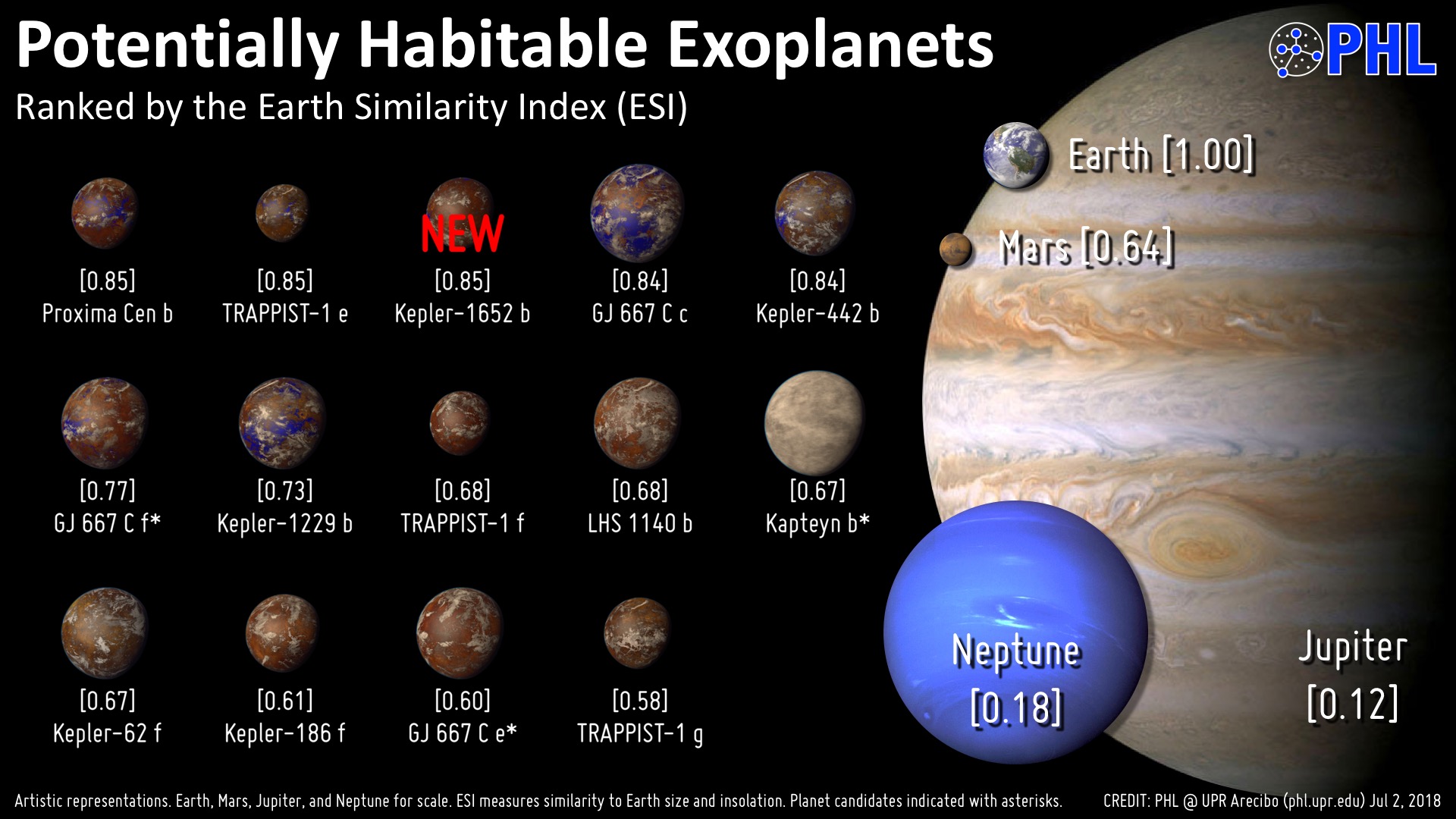
¿Encontraremos algún día vida extraterrestre? Para encontrar una respuesta afirmativa a esta pregunta, misiones como Kepler sondean el espacio en busca de posibles mundos similares a la Tierra. Localizar estos exoplanetas "objetivo" nos permite centrar mejor la búsqueda de organismos vivos fuera del Sistema Solar. Los investigadores habían señalado hasta la fecha el potencial de Kepler-438b, considerado como el exoplaneta más destacado, ya que cuenta con un índice de similitud con el planeta Tierra del 88%.

Las esperanzas depositadas en este mundo, denominado popularmente como "otra Tierra" desde su descubrimiento en enero de 2015, han sufrido un inesperado revés. Un estudio, publicado en la revista Monthly Notices of the Royal Astronomical Society, afirma que las grandes cantidades de radiación que recibiría Kepler-438b convertirían a este exoplaneta en un "lugar inhabitable". El mundo, que es un 12% más grande que la Tierra, estaba considerado hasta el momento como una especie de "gemelo planetario". Solo que se encuentra fuera de nuestro Sistema Solar, a 470 años luz, en un lugar conocido como "Ricitos de oro" (Goldilocks).
Según fuentes consultadas por Hipertextual, la investigación ha analizado parámetros como la rotación, la luz y las llamaradas solares que reciben diversos exoplanetas, entre los que también está Kepler-438b. De acuerdo a los científicos de la Universidad de Warwick, "la atmósfera podría haberse desvanecido como consecuencia de la radiación emitida por la enana roja a la que orbita". Como nos explica David J. Armstrong por correo electrónico, "Kepler-438b está cinco veces más cerca de su estrella que la distancia que separa a la Tierra del Sol". Esta proximidad provoca a su vez que las grandes llamaradas emitidas tengan un efecto mayor en el exoplaneta.

"Como resultado, hay una gran cantidad de radiación golpeando a Kepler-438b", nos cuenta Armstrong. Si hubiese una atmósfera protegiendo al exoplaneta, sería mucho más difícil que esto sucediera. Por desgracia, laseyecciones de masa coronal (en forma de explosiones de plasma, electrones y protones) de la enana roja parecen haber "despojado fácilmente" la atmósfera de Kepler-438b, prosigue el astrofísico, primer firmante del artículo. Al perder esta "capa protectora", el exoplaneta se vería afectado por unas elevadas tasas de radiación, que reducen mucho las posibilidades de que esté habitado. Para confirmar estas conclusiones iniciales, Armstrong apunta que deberíamos estudiar la atmósfera (si aún contara con algún resto), pero su lejanía complica mucho los trabajos.
A pesar de que se han reducido las probabilidades de habitabilidad del exoplaneta más parecido a la Tierra, el científico se muestra optimista. "Se trata solo de un mundo, tenemos muchos más sistemas que podrían ser propicios para hallar vida extraterrestre", comenta a Hipertextual. Según Armstrong, la investigación ha permitido demostrar que "no todos los exoplanetas similares a la Tierra son buenos lugares para la vida tal y como pensamos que existiría". Preguntado sobre el futuro de la Tierra y el Sol, el astrofísico rechaza que pudieran vivir en el futuro un proceso parecido al experimentado por Kepler-438b. "El Sol es una estrella muy diferente a esta enana roja. Lo que probablemente nos encontremos dentro de miles de millones de años es un Sol convertido en una gigante roja, que se expandirá y probablemente engullirá a la Tierra". Un escenario sumamente lejano en el tiempo que, posiblemente, no llegaremos a ver nunca.

Fuente: Hipertextual

29 de septiembre de 2010

A Habitable Exoplanet — for Real This Time

After years of saying habitable exoplanets are just around the corner, planet hunters have finally found one. Gliese 581g is the first planet found to lie squarely in its star’s habitable zone, where the conditions are right for liquid water.

“The threshold has now been crossed,” said astronomer R. Paul Butler of the Carnegie Institution of Washington, one of the planet’s discoverers, in a press briefing Sept. 29. “The data says this planet is at the right distance for liquid water, and the right mass to hold on to a substantial atmosphere.”

The discovery is both “incremental and monumental,” comments exoplanet expert Sara Seager of MIT, who was not involved in the new study. When a recent study predicted the first habitable world should show up by next May, Seager rightly said the real answer was more like “any day now.”

“We’ve found smaller and smaller planets that got closer and closer to the habitable zone,” she said. “But this is the first that’s in the habitable zone.”

The new planet is one of six orbiting the star Gliese 581, a red dwarf 20 light-years from Earth. Two of the planet’s siblings, dubbed planets C and D, have also been hailed as potentially habitable worlds. The two planets straddle the region around the star where liquid water could exist — 581c is too hot, and 581d is too cold. But 581g is just right. The discovery will be published in the Astrophysical Journal and online at arxiv.org.

The new planet is about three times the mass of Earth, which indicates it is probably rocky and has enough surface gravity to sustain a stable atmosphere. It orbits its star once every 36.6 Earth days at a distance of just 13 million miles.

The surface of a planet that close to our sun would be scorching hot. But because the star Gliese 581 is only about 1 percent as bright as the sun, temperatures on the new planet should be much more comfortable. Taking into account the presence of an atmosphere and how much starlight the planet probably reflects, astronomers calculated the average temperature ranges from minus 24 degrees to 10 degrees above zero Fahrenheit.

But the actual temperature range is even wider, says astronomer Steven Vogt of the University of California, Santa Cruz, who designed some of the instruments that helped find the planet. Gravity dictates that such a close-in planet would keep the same side facing the star at all times, the same way the moon always shows the same face to Earth.

That means the planet has a blazing-hot daytime side, a frigid nighttime side, and a band of eternal sunrise or sunset where water — and perhaps life — could subsist comfortably. Any life on this exotic world would be confined to this perpetual twilight zone, Vogt says, but there’s room for a lot of diversity.

“You can get any temperature you want on this planet, you just have to move around on its surface,” Vogt said. “There’s a great range of eco-longitudes that will create a lot of different niches for different kinds of life to evolve stably.”


Another advantage for potential life on Gliese 581g is that its star is “effectively immortal,” Butler said. “Our sun will go 10 billion years before it goes nova, and life here ceases to exist. But M dwarfs live for tens, hundreds of billions of years, many times the current age of the universe. So life has a long time to get a toehold.”

The discovery is based on 11 years of observations using the HIRES spectrometer at the Keck Telescope in Hawaii, combined with data from the HARPS (High-Accuracy Radial-velocity Planet Searcher) instrument at the European Southern Observatory in La Silla, Chile.

Both instruments looks for the small wobbles stars make as their planets’ gravity tugs them back and forth. The HIRES project started looking for planets 25 years ago, back “when looking for planets made you look like a nut,” Butler said. At first the instruments could detect changes in a star’s velocity that were 300 meters per second or larger. That’s why the first extrasolar planets discovered were almost exclusively hot Jupiters: These monstrous planets that sit roastingly close to their stars will exert a bigger gravitational pull.

Since then, techniques have improved so that changes as small as 3 meters per second can be seen. That wouldn’t be enough to see Earth from 20 light-years away, Butler says. Because red dwarfs are so small and their habitable zones so close, though, Earth-sized planets have enough gravitational oomph to make a difference.

“The excitement here is that by looking at stars that are small it’s much easier to find small planets,” said exoplanet expert David Charbonneau of Harvard, who is hunting for small planets that cross in front of dwarf stars. “I think it’s great news for those of us looking for this kind of thing around this kind of star.”

But finding them takes a long time. In all, 238 measurements of the star’s wobbles, went into the discovery, and each measurement took a full night of observing.

For Butler and Vogt, though, 11 years wasn’t so long to wait. He’s actually surprised that a potentially habitable planet showed up so quickly and so nearby.

“The fact that we found one so close and so early on in the search suggests there’s a lot of these things,” Butler says. Only about 100 other stars are as close to Earth as Gliese 581, and only 9 of them have been closely examined for planets. Odds are good that 10 to 20 percent of stars in the Milky Way have habitable planets, Vogt says.

Finding them won’t take a huge advance in technology, he adds. It will just take more telescope time.

“I have suggested that we build a dedicated automated planet finder to do this kind of work 365 nights a year,” he said. “If we had something equivalent to Keck that we could use every night, these things would be pouring out of the sky.”


Fuente: Wired Science

20 de septiembre de 2010

First Habitable Exoplanet Could Be Discovered by May

A new mathematical analysis predicts the first truly habitable exoplanet will show itself by early May 2011.

Well, more or less. “There is some wiggle room,” said Samuel Arbesman of the Harvard Institute for Quantitative Social Science, lead author of a new paper posted online and to be published in PLoS ONE Oct. 4. His calculations predict a 50 percent probability that the first habitable exoplanet will be discovered in May 2011, a 66 percent chance by the end of 2013 and 75 percent chance by 2020.

“This is, as far as we can tell, right around the corner,” said exoplanet expert Greg Laughlin of the University of California, Santa Cruz, co-author of the paper.

Astronomers have found 490 planets outside our solar system to date, and those planets have been getting steadily smaller and more Earth-like. But none so far actually resemble Earth in its most important property: the ability to support life.

So Arbesman and Laughlin devised a mathematical way to define habitability using the techniques of scientometrics, the scientific study of science itself.

The pair considered a planet’s mass and its surface temperature at the points in its orbits when it is closest and furthest away from its star, and calculated which of these properties would be friendliest to liquid water (and, therefore, presumably, life). Then they plotted their habitability function on a scale of 0 to 1, where 0 is uninhabitable and 1 is a clone of Earth.


Next, the researchers turned to the exoplanets that have already been found. They calculated the habitability metric for 370 exoplanets whose masses and distances from their stars are relatively well-known, and plotted that number against the planet’s date of discovery. Then they used a statistical method called bootstrapping, which looks at subsets of data to get a better idea of the overall distribution, to extrapolate forward to a planet with a habitability value of 1.

The median date for this planet to make its grand entrance, they found, is early next May. And the planet-hunting Kepler spacecraft may not be the one to find it, the researchers add.

“To find the really good stuff that Kepler is going to detect is going to take a few years,” Laughlin said. “Because the mission has only been flying for a bit more than a year, they just haven’t had time to find the planets that are genuinely habitable. Though they will.”

“We simply wanted to say it’s an open field, we don’t know who’s going to win,” Arbesman said. “But it seems like whoever does win, it’s going to happen soon.”

Exoplanet expert Sara Seager of MIT says she’s not surprised.

“They made a prediction you could probably make without all that probability,” she said. “People are specifically searching for planets that have liquid water. Just knowing how many people are looking and how many stars they’re looking at…. If you want a big Earth around a small star, that could happen any day.”

Arbesman and Laughlin admit their habitability metric is a little optimistic and their analysis leaves out factors like the march of technology. “It’s not a scientific result, it’s not a discovery,” Laughlin said. “It’s just something to spark discussion, to point out an interesting trend.”

And if they’re wrong, he adds, we’ll know soon enough.


Fuente: Wired Science

4 de septiembre de 2010

‘Earth-like’ Exoplanet Could Have a Comet’s Tail


When the super-Earth COROT-7b was discovered in 2009, it was heralded as the rockiest, most truly Earth-like exoplanet yet. But a new study suggests it’s more like a comet.

In a paper to be published in the journal Icarus, an international team of astronomers led by Alessandro Mura of the Italian Institute for Interplanetary Space Physics in Rome argue that, given the planet’s likely composition and distance from its star, COROT-7b probably loses its surface elements to space in a long, comet-like tail of charged particles.

COROT-7b is less than twice the size of Earth and about five times Earth’s mass, and orbits a sun-like star about 390 light-years away. Because COROT-7b’s density is similar to Earth’s, astronomers hailed it as the first rocky exoplanet discovered and one of the best candidates for hosting extraterrestrial life.

But the rocky world also sits almost 100 times closer to its star than the Earth is to the sun, and it orbits its star once every 0.85 Earth days. The temperature on the daylight side of the planet is a scorching 4000 degrees Fahrenheit, hot enough for minerals on the rocky surface to break down and release charged particles into space, where they would be picked up and blown away by the stellar wind.

“We expect that the stellar radiation pressure and the plasma environment will cause the build-up of an elongated comet-like exosphere,” the authors write. Depending on what the planet is made of, and whether it was once the rocky core of a “super-Neptune” as some have suggested, the tail could be composed of elements like sodium, oxygen, magnesium or silicon oxide.

The researchers compare this vision of COROT-7b with Mercury, which has a similarly antagonistic relationship with the sun and also leaks charged particles in a long tail.

“The planet appears to be more like a ’super-Mercury’ under much extremer environmental conditions,” the researchers write.

The team suggests that a tail composed of sodium or calcium could theoretically be detected on COROT-7b from ground-based telescopes. Although detecting such a tail would probably eliminate COROT-7b as a candidate habitable world, “this project would be the very first attempt to learn something of the mineralogy of a rocky planet orbiting another star.”


Fuente: Wired Science

Glint of Starlight Could Reveal Liquid Oceans on Exoplanets


The sparkle of starlight off water could be the clincher for finding oceans on extrasolar planets. And it could be observable with the tech that will be deployed in the next generation of space telescopes.

“A glinting planet looks different from a non-glinting planet, and it’s detectable with current technology,” said Tyler Robinson, a graduate student at the University of Washington and lead author of a new paper in Astrophysical Journal Letters. “This is one step toward proving there’s liquid water at the surface of an extrasolar planet.”

The proposed technique for finding wet worlds takes advantage of the same effect that makes sunsets on the Pacific coast so spectacular. The idea was suggested by Carl Sagan in 1993, and has been used to confirm the presence of liquid lakes on Saturn’s moon Titan.

“The oceans do a really good job of reflecting light like a mirror,” Robinson said. “Especially when you have the sun really low on the horizon, most of the sunlight comes reflected off of the water towards you. The same thing happens on the scale of a planet.”

Robinson and his colleagues showed that when a planet appears crescent-shaped to an Earthly observer, starlight reflecting off oceans can make the planet appear up to twice as bright as a planet with no oceans. They also showed that the sparkle of starlight off oceans looks different from light scattered through clouds.

Most other proposed techniques for finding water on an extrasolar planet rely on taking its spectrum, or detailed measurements of the planet’s atmosphere, and looking for the chemical fingerprint of two hydrogen atoms and one oxygen. But this strategy would show only that the planet hosts water vapor, not liquid oceans, and the technology is still a long way off.

“To get a good spectrum would require a big telescope that is still 10 or 20 years away from being designed or launched,” said exoplanet expert Darren Williams of Penn State University, who has also studied ways to search for exo-oceans but was not involved in the new work. “That’s really becoming a long-range, futuristic sort of thing.”

Robinson and his colleagues proved that the glint effect could be observable with the telescope touted as the successor to Hubble: the James Webb Space Telescope, slated to launch in 2014. If the telescope is accompanied by a shield to block starlight, as suggested in the New Worlds Observer mission concept, it will be sensitive to the light glinting off extrasolar oceans.

To test whether the glint would be visible to the new space telescope, Robinson imagined he was an alien observer looking back at Earth. He used data from weather satellites and NASA’s EPOXI mission to build a computer model of what Earth would look like to a distant observer, including weather patterns, seasonal changes and wind speeds over the oceans that would influence the height of waves.

The model “does explain what we can observe on our own planet from other spacecraft in the solar system, so you can trust the model that they’re using to do these calculations,” Williams said.

Unfortunately, even the James Webb Space Telescope won’t be able to take sharp enough images of exoplanets to tell whether the planet is in a crescent phase, much less directly see a glint. The telescope will just see a dot of light getting brighter and dimmer as it circles its star.

“We have to look for evidence of this glint when we just have this pale, tiny speck of light on our camera,” Robinson said.

So Robinson and colleagues added up all the light reflected by the model Earth to see if the glint would light up the whole planet enough to be seen from space. They found that Earth in the crescent phase would be twice as bright with a glint as without it. “That’s significant,” Robinson said. “A factor of two is a really big deal.”

The researchers also found that the glint effect is strongest in the near infrared part of the electromagnetic spectrum, just beyond what the human eye can see. These wavelengths of light are not as badly scattered as they pass through a planet’s atmosphere. Conveniently, they are also the wavelengths that the new space telescope will be most attuned to.

“The James Webb Space Telescope is really well suited to do this,” Robinson said.

Looking for the glint would not be the first line of investigation, however. Rather, Robinson imagines the technique could confirm that a good exo-Earth candidate, a plant that is about Earth’s size planet and lies the right distance from its star to support liquid water, actually does have oceans at its surface.

“We would first worry about whether the planet is even remotely Earthlike before looking for the glint,” he said.

“What’s nice about this result here is that we have a chance of doing interesting things with Earthlike planets with the James Webb Space Telescope, which is basically sitting on the hangar waiting to be launched into space,” commented Williams. “We can do that in our research lifetimes. That’s the most exciting thing about this.”


Fuente: Wired Science

2 de septiembre de 2010

New Technique Finds Gaseous Metals in Exoplanet Atmospheres


A previously undetected element has been found in the atmospheres of two different extrasolar planets. Using a new technique at a new telescope, two separate groups of exoplanet scientists have discovered potassium in the atmospheres of two hot Jupiters more than 190 light-years from Earth.

“I’m really excited about this,” exoplanet expert Sara Seager of MIT, who was not involved in the new discoveries, said in an e-mail. “Together with other ground-based advances it is changing exoplanet atmosphere studies in a huge way.”

The two groups, one led by exoplanet scientist David Sing of the University of Exeter and the other led by University of Florida grad student Knicole Colón, used the 34-foot-wide Gran Telescopio Canarias in the Canary Islands to observe the planet XO-2b, located around 500 light-years from Earth, and the planet HD 80606b, about 190 light-years from Earth.

Both planets pass in front of their stars, or transit, from the vantage point of Earth. As the planet crosses its star’s face, some of the light from the star seeps through the glowing ring of the planet’s upper atmosphere. Different atoms and molecules interact with light in specific ways, so observing the light that makes it through the atmosphere allows scientists to figure out what elements it contains.

The two teams both used a new technique called narrowband transit spectrophotometry to focus in on potassium. Earlier studies of exoplanet atmospheres looked at all the light passing through the planet’s atmosphere, which restricted them to studying only the brightest stars. But Sing, Colón and their colleagues used a special filter that looks only at the particular wavelengths of light where potassium was expected to be found. The results are online at arXiv.org and will be published in two papers in Astronomy & Astrophysics and the Monthly Notices of the Royal Astronomical Society.

The new technique will eventually let astronomers measure the atmospheres of smaller planets around dimmer stars, says University of Florida exoplanet expert Eric Ford, a co-author of the paper describing HR 80606b.

“We can study these small planets, whether they’re mini-Neptunes or super-Earths, and answer some questions about them now, rather than waiting for next generation of big space telescopes,” he said.

These first two potassium-bearing planets are strikingly different. XO-2b is about the size of Jupiter, a little more than half Jupiter’s mass, and revolves sedately around its star once every 2.6 Earth days. Sing and his colleagues found a clear signature of potassium gas as a stable component of the planet’s atmosphere.

HD 80606b, on the other hand, is four times the mass of Jupiter and flies around its star in a crazy elliptical orbit that more closely resembles a comet’s orbit than a planet’s. The planet is flash heated as it comes close to its star, and then cools down again as it veers away. The atmospheric data suggests the potassium gas condenses into clouds when the planet is far from its star, and is being driven away from the planet by high-speed winds.

“They’re seeing a signature of that atmosphere being essentially boiled away as it goes by the star,” said exoplanet scientist Ruth Murray-Clay of Harvard, who was not involved in the new work. “It’s pretty extreme.”

Ultimately, astronomers would like to compare the amounts of several elements in the atmospheres of many different planets.

Seager and her colleagues predicted 10 years ago that potassium and sodium, both of which are solid on Earth, should be important gasses in most hot Jupiter atmospheres. But the first two planets to have their atmospheres analyzed showed only sodium.

The new discoveries “tell us that some of the basic models for hot Jupiter atmospheres that were proposed 10 years ago are pretty much right, in their gross characteristics,” Murray-Clay said. “It gives us some confidence that we have some idea of what’s going on, at least in the really hot ones.”

The fact that two potassium-bearing planets were announced on the same day indicates astronomers are moving into a new stage in exoplanet discoveries, Seager adds.

“Until now, in exoplanets, we’ve had interesting things that scratch the surface. You might find one molecule in one planet, or one new planetary system,” she said. “Now we’re on this watershed where all of a sudden, you could study 100 transiting planets with this technique. We’re moving into a much deeper level of work in exoplanets.”


Fuente: Wired Science

Exoplanet Shows Gas Giants Start as Dusty Behemoths


The atmosphere of a young exoplanet didn’t fit any of our existing models for what gas giants should look like. But when astronomers added huge dust clouds, it was a perfect fit, perhaps revealing a larger truth about gas giants.

The planet in question is HR 8799 b, a gas giant about seven times the mass of Jupiter. It’s one of three gas giants revolving around the star HR 8799, located about 1,300 light-years away. The system was first discovered in 2008, and now astronomers have been able to perform spectroscopic analysis of the planets. These analyses are extraordinarily powerful, giving us close approximations of the planet’s chemical composition, cloud properties, and even temperature.

We can figure out the temperature of an exoplanet by measuring the amount of methane in its atmosphere. According to the almost nonexistent methane levels on HR 8799, its temperature couldn’t be any cooler than about 1,700 degrees Fahrenheit. But other metrics, such as the planet’s apparent youthful age and the amount of energy it’s sending out, suggest it should be about 250 degrees cooler than that, assuming our current models are right.

As it turns out, our models are wrong, or at least they didn’t take into account the possibility of massive dust clouds on HR 8799 b. When those clouds are added into the equation, the data fits together perfectly and explains the 250 degree swing. Because this particular gas giant is one of the youngest we’ve ever observed and analyzed, it’s quite possible that this extreme dustiness is just a natural part of a gas giant’s infancy, which tells us something about the beginnings of our own solar system’s four gas giants.


Fuente: Wired Science

14 de julio de 2010

Sun’s Dust Ring Could Help Find Exo-Earths


Earth-like exoplanets could announce their presence through trailing clumps of dust — and new observations of the Earth’s own dust cloud could provide a way to find them. Over the course of five years, the Spitzer Space Telescope drifted through a diffuse but extensive ring of dust particles that orbit the sun in lockstep with the Earth, showing astronomers for the first time what the dusty signature of an exo-Earth might look like.

“For the first time we can measure the structure of that cloud along the Earth’s orbit, using this moving space probe that travels through the cloud,” said astronomer William T. Reach of the Universities Space Research Association, the author of a paper to appear in the journal Icarus. “We can use that as a key, as a template, to understand the dust around other stars.”

The observations showed that a ring of dust from comet tails and broken asteroids follows the Earth in its orbit, something astronomers had already suspected. The dust particles are about 0.02 millimeters in diameter or larger. An extra-thick cloud of these particles about 7 million miles wide trails behind the Earth at about 80 times the distance from the Earth to the moon. Spitzer, which follows the Earth in orbit around the sun, sent images from directly inside this cloud from its launch in 2003 until its coolant ran out in 2009.

Astronomers’ first whiff of this trailing dust clump came in 1984, when the IRAS spacecraft showed that the sky is brighter in infrared wavelengths when looking backward along the Earth’s orbit than when looking forward. Because dust glows in the infrared, the lightened sky was a clear sign that more dust follows the planet than leads it.

“We couldn’t figure out for the life of us what the hell was going on,” said astronomer Mark Sykes, now the director of the Planetary Science Institute in Arizona, who worked on the IRAS project. No good explanations emerged until the early ’90s, when astronomer Sumita Jayaraman, also now at the Planetary Science Institute, realized that individual dust particles could get temporarily trapped in a special gravitational relationship called a resonant orbit with Earth.

Most of the dust in the plane of the solar system, called the zodiacal cloud, will eventually spiral into the sun. But particles of the right size, tens of micrometers across, can feel a little gravitational push as they float by the Earth. That push counteracts the sun’s pull just enough to hold the dust particles in a loose halo around the sun. The subtle interactions of the Earth and the dust grains’ movements lead to the backward-facing clump.

Mathematical models of the dust ring gave astronomers an idea of the clump’s extent, but the Spitzer observations were the first chance to test them.

“This work is great because it provides us a novel way of probing the structure of this cloud, which could then feed back into these detailed dynamical models of the dust,” Sykes said.

The observations can feed models of what dust rings associated with extrasolar planets might look like. Of the few extrasolar planets to have their pictures taken by direct imaging, at least two hinted at their presence by warping the disk of dust and gas around their star. Earth-like planets that are too small or dim to find through usual methods may have a subtle but detectable influence on their dust disks.

“It’s a way that we can recognize planets around other stars that we can’t necessarily see,” said NASA exoplanet scientist Marc Kuchner. “This result make it much easier to compare solar system dust clouds with ones we see in the disks.”

But the dust can be misleading too, Kuchner warns. “They can be bad news if you’re trying to directly image a planet, because they can masquerade as planets themselves,” he said. “It’s both the signal and the noise.”


Fuente: Wired Science

20 de junio de 2010

Exoplanet Hunters Finally Catch One in a Star’s Debris Disk


A giant planet lurks in the dust and debris surrounding a young, nearby star — and astronomers have finally seen it in action.

Using the Very Large Telescope in Chile, astronomers took infrared images of the planet in two different positions around its star in 2003 and late 2009.

“It’s so exciting that we can see it,” said astronomer Paul Kalas of the University of California, Berkeley, who was not involved in the new work. “We’ve been looking a long time.”

The discovery, announced June 10 in Science, proves that giant planets can form quickly around young stars and suggests that dust disks are signposts for stars hosting giant planets.

Beta Pictoris, a star almost twice the mass of the sun and located 63 light-years away, has been a celebrity among planet hunters since the 1984 discovery of a wide halo of dust and rocky debris that could eventually coalesce into planets. Later observations showed that the disk was oddly warped, and that it had a big hole near the center.

Theoretical models predicted that a planet around five to 10 times the mass of Jupiter could make both the warp and the hole. But when Anne-Marie Lagrange of the Grenoble Observatory in France, first author of the new paper, and her colleagues observed the star in 2003, they saw nothing.

“The tools we had in 2003 were not precise enough,” she said.

After Kalas’s group and another team released images of planets around the stars Fomalhaut and HR 8799 in November 2008, Lagrange and colleagues tried again. They used newer techniques to cancel out the light from the star, allowing the planet to shine through.

The image showed a bright object next to Beta Pictoris, but whether it was a planet or another star in the background was unclear.

“Frankly, if I had a bet on whether or not they’d actually seen a planet back in 2003 … I would definitely bet it was not a planet,” said astronomer Ben Zuckerman of the University of California, Los Angeles, who was involved in imaging the planets around HR 8799.

Follow-up observations in late 2008 and early 2009 also came up empty. Finally, in October 2009, the planet re-emerged on the other side of the star. Lagrange and colleagues kept taking images until March 2010 to confirm that the object was a planet.

“We spent a really long time, nights and days, to check it,” she said. “It really shows that when we see disks, we have to look at every detail, because they can indicate the presence of a planet.”

Because Beta Pictoris is such a young star — about 10 million years old, or two thousandths the age of the solar system — studying its planetary system can help astronomers decide between competing models of planet formation. For instance, earlier theoretical work showed that debris disks around stars broke up fairly quickly, within a few million years. Some theorists worried that massive planets wouldn’t be able to form fast enough, but the planet around Beta Pictoris is proof that they can.

“It’s taking a snapshot of another solar system right after it’s born,” Kalas said. “The other alternative is to invent a time machine and go back 4.5 billion years and look at our own Jupiter when it just formed. But obviously we can’t do that.”

The planet weighs in between six and 12 times the mass of Jupiter, similar to the models’ predictions. It orbits its star at about the orbit of Saturn, between eight and 13 times the distance from the Earth to the sun, making it the closest planet to a star ever imaged. It also means the planet makes a complete circuit around its star every 17 to 30 Earth years, well within human lifetimes.

“Eventually, we’ll have a movie of this planet going around Beta Pic,” Kalas said. By contrast, the planets around HR 8799 and Fomalhaut take between 100 and 870 years to complete an orbit.

The next step is to observe the planet in more wavelengths to get an idea of what its atmosphere is made of, Lagrange said. And with new instruments like the Gemini Planet Imager coming online, the next few years should see even more direct images of extrasolar planets.

“The future is really bright,” said astronomer Christian Marois of the National Research Council of Canada’s Herzberg Institute of Astrophysics. “It’ll be a really interesting field in the next two or three years.”


Fuente: Wired Science

Exoplanet Hunter’s First Data Withholds the Good Stuff


The planet-hunting space telescope, Kepler, released its first big batch of data today.

That should be exciting, but the team held back the good stuff until February 2011, wanting to analyze and follow up on the early observations themselves. Kepler is trying to find Earth-like planets that exist at just the right distance from their home stars to retain water in liquid form.

Of the 156,000 target stars in the telescope’s field of vision, the 43 days of observations found 706 possible extrasolar planets from Earth size up to a bit bigger than Jupiter. Today, the NASA Ames Research Center crew, led by William Borucki, released data on the 306 targets they’re least excited about. Their top 400 candidates to investigate as possible Earth twins will not be announced for eight more months.

“Many of the candidates are likely to be false positives and the brighter stars, and those with the small-size candidates … are among the 400 withheld targets and are thus not among those considered here, biasing the results toward the dimmer stars and larger candidates,” Borucki wrote in an article posted to arXiv.org.

The data release plan was approved earlier this year by a special NASA advisory board, but has recently touched off controversy over its fairness and wisdom.

Without all the data in hand, it’s hard to answer the question that Kepler was built to answer: How common are planets like Earth? Though we now know hundreds of exoplanets, most of them are big, hot Jupiters around very bright stars that could not sustain any kind of life that we recognize. It’s easy to detect the bigger planets that orbit close to their stars because their gravity makes the star “wobble” more noticeably and their size dims its light more. So, the data we’ve collected on extrasolar planets over the last two decades is muddied by observation bias.

Borucki’s mission, which he pushed for over decades before finally getting funding, is like a stellar census that may reshape our notions about the prevalence of life and the habitability of the universe. By figuring out how many Earth-like planets exist, we will have a much better idea about some key variables in the Drake equation, which attempts to describe the likelihood of finding intelligent life.

The mission is complicated by the fact that it finds planets by monitoring stars that periodically dim when planets cross in front of them. For us to see that happening from our solar system, we have to be very precisely aligned with the other star and planet. And we may have to wait a very long time for a planet like Earth to orbit its star twice: Alien astronomers would have to wait two years to observe our planet transiting the sun twice.

“If we were to assume that every star had an Earth-like planet in an Earth-like orbit, the likelihood we could see it is half of a percent,” said Charles Sobeck, a systems engineer at NASA Ames and the deputy project manager of the Kepler mission. “You not only have to have it lined up, the star has to be bright enough too.”


Fuente: Wired Science

24 de mayo de 2010

Planetary Bullies Make Astronomers Rethink the Habitable Zone


Exoplanet orbits that seem just right for life could be bent out of shape by pushy neighbors. New simulations of extrasolar planetary systems may mean the definition of "habitable" planets needs to be completely overhauled.

When astronomers talk about the "habitable zone," they mean the shell around a star where the temperatures are right for liquid water. Any closer, and oceans will boil. Any farther, and the planet will freeze. But this definition assumes that most planets have roughly circular orbits, like the Earth and most other planets in the solar system.

"What we know from studying exoplanets is that that is definitely not the rule," said Rory Barnes of the University of Washington at the meeting of the American Astronomical Society in Miami. Many of the 454 exoplanets discovered to date have highly elliptical orbits, meaning the planets are not always the same distance from their parent star. Thanks to this uneven geometry, the planet spends more time closer to its star, which tends to make for warmer planets.

Adding another planet, especially a bullying Jupiter-sized planet, can mess with orbits and make a once-hospitable planet move in and out of the habitable zone over time. Using computer simulations of several hypothetical planetary systems, Barnes showed that a giant neighbor can pull an Earth-like planet’s orbit like a rubber band, shifting it from circular to elliptical and back to circular again in as little as a few thousand years.

"It’s a very stable, repetitive process," Barnes said.

The Earth’s orbit actually does feel similar nudges from Jupiter, known as Milankovitch Cycles. But luckily for us, these orbital shape shifts are subtle.

Barnes’ simulations predicted more-dire consequences for extrasolar planets near the edge of their habitable zones, though. If the planet is on the cooler edge of the habitable zone, it could go through cycles of freezing and thawing. If it’s on the warmer side, the temperature could fluctuate from comfy to boiling from one millennium to the next.

"The inner edge is much more dangerous," Barnes said. All the water could boil off and be lost forever, or the warming planet could experience a "runaway greenhouse" effect and end up a scorched wasteland like Venus.

But it’s not all bad news. Barnes suggests that some planets we might dismiss as snowballs could just be going through an eccentric phase.

"Our own Earth has gone through stages of glaciation — we call them snowball Earth phases — and we managed to pull out of it," he said. "On a planet like that, on the outer edge, you will have reservoirs of life, and there will be habitats that will persist."

For planets around dim, low-mass stars, which have to be especially close to be in the habitable zones, neighboring giant planets could wreak havoc with the length of the day, and the gravitational pull could cause cycles of volcanic activity and earthquakes interspersed with relative calm.

"These are fascinating worlds to think about," Barnes said. "It will do lots of interesting things as far as how climates might evolve and how evolution might happen on such a planet."

The results suggest that the current definition of "habitable zone" may be too simplistic. Astronomers may have to consider the whole family of exoplanets in a system before determining if one is habitable or not.

"One of the things that this new work is emphasizing is that one needs to be very careful about defining habitability," commented Phil Armitage of the University of Colorado, Boulder. "Those ideas about terrestrial planet formation and habitability of terrestrial planets will need to be re-evaluated from scratch."


Fuente: Wired Science

20 de mayo de 2010

Hubble Watches as Star Slowly Devours Planet


Six hundred light-years from Earth, a huge exoplanet circling close to its home star is slowly, inexorably being devoured.

WASP 12B orbits just 2 million miles from its star, which means the surface of the planet reaches temperatures over 2,800 Fahrenheit. The sun’s gravitational pull is stronger on the front surface of the planet than on the back, so the planet has been pulled into a football shape. If you were floating on the gaseous planet, and looking heavenwards, the sun would take up nearly the entire sky.

And in the next 10 million years, the star that so dominates the planet will be destroy it, according to a paper published in May in The Astrophysical Journal Letters.

It’s not exactly the kind of solar system that human beings anticipated finding in the great beyond.

"All sorts of things that we would never expected to find we’re finding,” said Carole Haswell, an astronomer at The Open University in Great Britain and the lead author on the new paper. “Our preconceptions about what planetary systems might look like were shaped by what our own solar system looked like, particularly Star Trek," she joked.

She and her team used the Hubble Space Telescope’s Cosmic Origins Spectrograph to investigate the planet by looking in the ultraviolet part of the spectrum.

"The near ultraviolet is a very sensitive probe to the presence of stuff and that allows you to deduce an effective radius for the planet," she said.

WASP 12B has a puffed up atmosphere that its star is siphoning off. That observation happily matches theoretical predictions made just a few months ago by astronomer Shu-lin Li at Peking University, Beijing. The confirmation shows yet again that exoplanetology, particularly the study of other solar systems not just individual planets, is advancing at a breakneck pace.

"It is a really nice example of theorists predicting something and we’d already observed something close to what they predicted," Haswell said.

To date, 455 exoplanets have been discovered.

Fuente: Wired Science

17 de abril de 2010

Rampaging Hot Jupiters May Keep Earthlike Planets Out of Their Systems


A bevy of backward-orbiting exoplanets could challenge theories of planet formation, new research suggests. The planets’ wonky orbits might also rule out the presence of Earthlike bodies in some planetary systems.

The wrong-way planets got where they are by cartwheeling over their stars’ heads, Andrew Collier Cameron of the University of St Andrews in Scotland proposed in an April 13 presentation at the Royal Astronomical Society’s National Astronomy Meeting in Glasgow, Scotland.

Planets are thought to form from the disk of gas and dust that surrounds a young star. Because the star and the disk both coalesce from the same cloud of material, theory holds that both should spin in the same direction — and so should any planets that arise. The "disk migration theory" posits that some planets should end up close to their stars by gently migrating inward over time, maintaining an orbital plane in line with the star’s rotation.

Last summer, astronomers first discovered a handful of planets that threw that idea for a loop. These planets orbit backward, opposite to the direction of their stars’ spin (SN: 9/12/09, p. 12). And other newly discovered planets that did have "forward" orbits were tilted 20 degrees or more with respect to the plane of the stellar disk where they were born.

These planets belong to a class of extrasolar planets called hot Jupiters — giants that sit scorchingly close to their stars.

"If I had to stick my neck out and make a prediction, it’s probably not a good idea to go looking for terrestrial planets in systems that have hot Jupiters in them," Cameron says.

Cameron and his colleagues think a single mechanism pushed the tilted and backwards planets into their offbeat orbits and also drew them close to their stars. If these slanted orbits are common, it could be a death knell for the migration theory, says study coauthor Didier Queloz of the Geneva Observatory.

"Migration cannot produce misaligned systems," Queloz says. The new study brings the total number of planets for which astronomers have angle data up to 27. Of those many are misaligned, with half tilted at steep angles and six orbiting backwards.

"Since most hot Jupiters are indeed misaligned, most cannot be formed by migrations," Queloz says. "We’re kind of killing this first idea of migration."


The more likely explanation, the researchers say, is the Kozai mechanism. In this scenario, a second, distant large body like a planet or a companion star gravitationally perturbs a planet’s orbit. The orbital plane can flip over the top of the star like a jump rope. When the orbit is flipped more than 90 degrees, the planet is orbiting backwards. At the same time, the shape of the orbit squishes and stretches like a rubber band. As the planet gets closer to the star, its orbit gets more circular, and the cartwheels become less dramatic. When the orbit finally settles into a circle near the star the tilt freezes.

Earlier research predicted that most orbits of giant planets perturbed by the Kozai mechanism should end up tilted around either 40 degrees — a forward but slanted orbit — or 140 degrees — a backwards orbit.

"That looks very much like what we’re now observing," Cameron says. "It looks almost too good to be true."

Some critics think he’s right — it is too good to be true. "I think they’re eliminating the standard mechanism of disk migration prematurely," says Adam Burrows of Princeton University. Some combination of migration, scatter and the Kozai mechanism is still possible, he says. "Their data isn’t that definitive to eliminate any other possibilities."

Astronomers had hoped that smaller, more Earthlike planets could be hiding in the neighborhoods of hot Jupiters, but the recent slug of orbital data suggests that may be unlikely. The giant planets’ orbits can take hundreds of thousands of years to settle, "during which you have a rampaging Jupiter on a cometlike crazy tumbling orbit, which would simply fling any remaining debris out of the system," Cameron says.


Fuente: Wired Science

7 de abril de 2010

Mystery Object Defies Astronomical Classification


A mysterious object discovered near a brown dwarf doesn’t fit into any known astronomical category.

The newly discovered mystery companion forms a binary system with the brown dwarf, located 460 light-years away in the Taurus star-forming system. The object is too light to be another brown dwarf, but it’s too young to have formed by accretion, the way a typical planet does.

“Although this small companion appears to have a mass that is comparable to the mass of planets around stars, we don’t think it formed like a planet,” said astronomer Kevin Luhman of Penn State University, co-author of the study April 5 in The Astrophysical Journal. “This seems to indicate that there are two different ways for nature to make small companions.”

Luhman’s team made the discovery with the Hubble Space Telescope and the Gemini Observatory. The discovery was made using the Wide Field Planetary Camera 2 on the Hubble Space Telescope and the Gemini Observatory.


The new object and its companion brown dwarf are orbiting as a binary pair, 15 astronomical units from each other. If they were superimposed on our solar system, the companion would be orbiting midway between Saturn and Uranus. The oddball object’s mass is somewhere between five and 10 Jupiter masses, making it too small to fuse deuterium. The International Astronomical Union currently uses this fusion line, which occurs at about 13 Jupiter masses, as the defining characteristic of a brown dwarf.

But the object appears to be around the same age as its binary partner, which doesn’t fit conventional ideas about planet formation. Traditional theories describe planets forming from the gaseous disk that swirls around the equator of a newly formed star. Particles in the gas and dust cloud collide, and gradually accrete into larger objects, eventually becoming planets. These rocky planets can grow into sizes up to 10 Earth masses before they become gas giants.

And 1 million years is much shorter than the expected time for a planet to be born this way. Planets can form this quickly when there is a gravitational instability in the gaseous disk, but the brown dwarf’s disk probably didn’t have enough material to form a planet larger than a single Jupiter mass.

“It looks like this new system formed by the collapse and fragmentation process that forms binary star systems,” Alan Boss, president of the IAU Commission on Extrasolar Planets said in an e-mail to Wired.com. Boss theorized that these sorts of planet-sized objects exist in a paper published in 2001.

“While people like to use the ‘p-word’ to describe objects with masses below 13 Jupiter masses, given the attention given to exoplanets these days, they should more properly be called ’sub-brown dwarfs,’” Boss said.

Because this strange object seems more likely to have formed the same way as its binary partner, the brown dwarf, Luhman believes it is probably best classified as a very small brown dwarf.

“This object, because it formed like a star, its composition is probably the same throughout,” Luhman said. This homogenous composition is in stark contrast to the innards of gas giants, like Jupiter, which probably have a heavy-element rocky core surrounded by a gaseous shell composed mainly of hydrogen and helium.

The presence of another nearby binary system, of a red star and a brown dwarf, supports Luhman’s theory. It seems to have been formed around the same time as the mystery pair, indicating that all four may have formed the same way, as stars.

“This configuration — two tight pairs that are widely separated from each other — is called a hierarchical configuration and is commonly seen in quadruple star systems,” Luhman said.


Fuente: Wired Science

17 de enero de 2010

Un 15% de las estrellas de la Vía Láctea podría albergar planetas tipo Tierra


Un nuevo estudio sostiene que el 15% de las estrellas de nuestra galaxia podrían albergar planetas “gemelos” a nuestra Tierra. Si el cálculo es correcto, esto significaría que hay varios cientos de millones de sistemas solares parecidos al nuestro ahí afuera.

La investigación se basó en un conteo de estrellas con planetas gigantes gaseosos – parecidos a Júpiter o Saturno – en órbitas lejanas. Esta condición es importante porque la lejanía de estos gigantes con respecto a su estrella madre crea un amplio espacio intermedio ideal para que los planetas rocosos como el nuestro alcancen las regiones habitable llamadas “ricitos de oro”, allá donde el agua pueder existir en su forma líquida.

Debra Fisher, conocida cazadora de exoplanetas de la Universidad de San Francisco (que no está relacionada con este estudio), cuenta que durante la primera década de la búsqueda de planetas extrasolares, los astrónomos se sintieron preocupados porque todos los sistemas que encontraban eran demasiado diferentes al nuestro.

Ahora Fisher opina que: “estos resultados nos reafirman en la idea de la existencia de sistemas solares similares al nuestro. Estos son datos reales que refuerzan la hipótesis de múltiples mundos habitables similares a la Tierra”.

Los astrónomos generalmente cren que los gigantes gaseosos se forman lejos de sus estrellas, mientras que los mundos rocosos se forman más cerca. Pero se cree, que en algunos sistmas solares los gigantes gaseosos pueden migrar al interior golpeando o destruyendo a su paso a los mundos rocosos.

Afortunadamente, como comenta Andy Gould, astrónomo de la Universidad Estatal de Ohio y coautor del estudio, existen sistemas solares como el nuestro en los que los gigantes gaseosos tienen órbitas estables y donde los planetas rocosos pueden prosperar sin recibir golpes. De hecho, en esta clase de sistemas los gigantes gaseosos actúan como escudos gravitatorios que protegen a los pequeños mundos interiores de las mortíferas lluvias de meteoritos.

Encontrar esta clase de sistemas extrasolares es algo en lo que casi 100 científicos están colaborando gracias a la red Microlensing Follow-Up Network (o MicroFUN). Para ello barren la galaxia usando una técnica basada en las microlentes gravitacionales. Básicamente este método consiste en usar el campo gravitatorio de una estrella cercana (ubicada en línea recta entre la Tierra y una estrella lejana) como una lupa.

De camino a la Tierra, la luz de la estrella lejana sufrirá una variación en su trayectoria y una magnificación, al atravesar el campo gravitatorio de la estrella lente intermedia. Si la estrella lente tiene planetas en órbita, los habilidos ojos de los observadores podrán detectar las sútiles pistas de su presencia en la luz magnificada.

Hace 10 años, los cálculos indicaban que el número de sistemas solares gemelos al nuestro podría ser del 45%. Hasta el momento, sin embargo, solo ha encontrado un sistema solar similar al nuestro. El hallazgo tuvo lugar en 2006 y la estrella contaba con su propia versión de Júpiter y Saturno. Si los cálculos iniciales de hace una década fueran correctos, deberían haber aparecido al menos seis sistemas. Por eso los científicos han rebajado ahora el porcentaje a un 15%.

De todos modos, a medida que el número de observaciones y la calidad de las mismas vayan aumentando, este porcentaje podría sufrir variaciones.


Fuente: Maikelnai's blog

17 de diciembre de 2009

Exotierras


Si pensásemos en un planeta que está tan cerca de su estrella que orbita cada 38 horas (es decir, cada año dura poco más de día y medio terrestre), no podríamos concebir que sus condiciones se asemejasen en nada a la Tierra. A no ser, claro, que este planeta orbite una estrella mucho más pequeña y fría que nuestro sol.

Pues bien, exactamente eso han descubierto astrónomos del centro astrofísico Harvard-Smithsonian. Se trata, en concreto, de lo que denominan una supertierra. En realidad, es bastante más grande que la Tierra, pero a la vez, bastante más pequeño que los gigantes gaseosos ‘medianos’ tipo Neptuno. Al igual que la Tierra, tiene atmósfera, es de carácter rocoso y… se cree que puede tener agua líquida en la superficie.

De todos los exoplanetas que se conocen (de momento, unos 400), sólo hay dos de características similares a la Tierra: el recién descubierto (que recibe el nombre de CJ1214b) y otro llamado Corot7b. Todos los demás son gigantes gaseosos. Esto no quiere decir que el planeta tenga condiciones aptas para la vida humana. Su temperatura no deja de ser demasiado elevada y además su atmósfera es densísisma, con lo cual la presión en superficie sería insoportable (es posible, incluso, que la luz de la estrella ni siquiera llegue a la superficie).

Resulta curioso el modo en el que este planeta ha sido descubierto. Los astrónomos responsables de la investigación decidieron centrarse en estrellas enanas rojas. Las estrellas medianas (como el sol), y no digamos las grandes, tienen un problema: los planetas (si los tienen) son demasiado pequeños como para que su presencia sea advertida al lado de la estrella (por ejemplo, el ‘eclipsamiento’ de la estrella debido al paso de un planeta es casi imperceptible). Por eso, se necesitaban los grandes telescopios de los observatorios o incluso el telescopio espacial Hubble.

Sin embargo, GJ1214b ha sido descubierto usado un equipamiento comparativamente muy sencillo, basado en telescopios de 16 pulgadas que están al alcance de astrónomos aficionados e investigadores modestos. Como las estrellas rojas tienen una luz muy débil, el paso de un hipotético planeta frente a ellas debería ser bastante notable.

Esa misma idea tuvo el equipo de astrónomos responsable del descubrimiento, y para ello, hicieron una lista de 2000 estrellas rojas para analizar. Apenas habían empezado a revisarlas, cuando les tocó la ‘lotería’: habían descubierto un exoplaneta. Esto significa que “o tenemos mucha suerte, o este tipo de planetas son muy comunes”, en palabras de David Charbonneau, líder del grupo.

Aunque de momento no se ha descubierto ningún exoplaneta que tenga condiciones claramente favorables a la vida, con descubrimientos como este se va cerrando el círculo, poco a poco.